
Sustainability Program
Building a More Sustainable New Mexico
New Mexico Department of Transportation (NMDOT) is integrating sustainability and resilience into transportation projects across the state, planning and design through construction, operations, and maintenance.
Guided by the Envision Sustainable Infrastructure Framework, the program provides a consistent way to identify opportunities that improve quality of life, strengthen communities, protect natural resources, and prepare infrastructure for future challenges.
Program Overview
A Consistent Approach Across the Project Lifecycle
Every transportation project presents opportunities to deliver long-term value. The NMDOT Sustainability Program helps project teams consider social, environmental, and economic outcomes early and carry appropriate sustainability features through design, construction, operations, and maintenance.
The approach is scaled to project type and complexity, allowing routine projects to make practical improvements while larger projects receive more detailed evaluation.
“The Envision framework is a decision-making tool that allows infrastructure owners, engineers, designers, architects, planners, contractors, and other stakeholders to evaluate projects across a broad range of sustainability indicators, or “credits,” that address environmental, social, and economic dimensions (the ‘Triple Bottom Line’) of sustainability to encourage systemic change.”
Why it Matters
Long-Term Value for New Mexico
By considering sustainability and resilience throughout project delivery, NMDOT can support safer and more reliable transportation, responsible use of public resources, environmental stewardship, and infrastructure that remains useful as conditions change.
Thoughtful decisions early in project development can improve long-term performance, reduce future disruption, and deliver greater value for New Mexico communities.
Benefits
Sustainability is not an added feature at the end of a project. It is a way to consider how transportation investments can perform better over time, use resources responsibly, respond to changing conditions, and continue serving New Mexico communities into the future.
Safer, More Reliable Infrastructure
Considering resilience throughout project development can help infrastructure better anticipate, withstand, adapt to, and recover from changing conditions and unexpected events.
Responsible Use of Resources
Sustainability considerations can help project teams identify opportunities to use materials, energy, and water more efficiently and reduce unnecessary environmental impacts.
Long-Term Value
Considering sustainability early can help reduce future disruption, support long-term performance, and make more informed use of public resources.
Stronger Communities
The program considers quality of life, mobility, community needs, environmental stewardship, and economic outcomes as part of a broader approach to infrastructure investment.
Greater Consistency and Accountability
Using a common framework gives project teams a consistent way to identify opportunities, document decisions, measure outcomes, and improve the program over time.
Decisions made today influence how infrastructure performs, what it costs to maintain, how well it responds to future conditions, and the value it provides to communities over time.
Envision: A Framework for Sustainable Infrastructure
Envision is a sustainability and resilience framework developed by the Institute for Sustainable Infrastructure. Organized into categories to provide project teams with a structured way to evaluate performance, document decisions, and identify opportunities for improvement.
NMDOT selected Envision because it aligns with state and agency goals and supports consistent project evaluation. Selected Signature Projects may also pursue optional third-party Envision Verification.
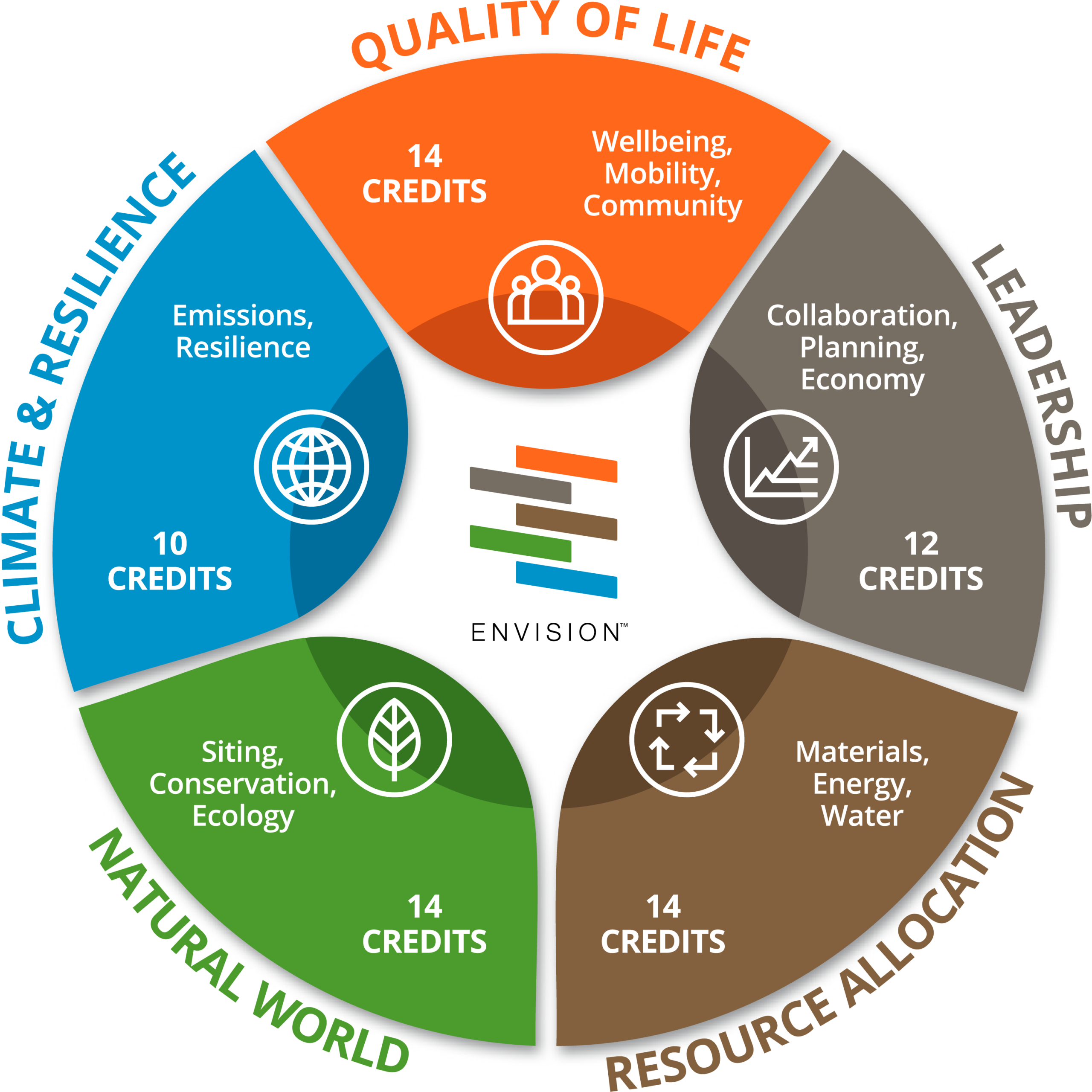
This framework includes 64 indicators, known as credits, organized into five categories: Quality of Life, Leadership, Resource Allocation, Natural World, and Climate and Resilience. Together, these categories address a wide range of topics, including community well-being, mobility, economic development, collaboration, planning, materials, energy, water, conservation, ecology, emissions, and resilience. Collectively, the credits define what sustainable infrastructure looks like and provide a comprehensive foundation for evaluating project performance.
Each of the 64 credits includes multiple levels of achievement, representing a range of performance goals—from modest improvements beyond conventional practices to outcomes that conserve and restore communities and natural environments. By evaluating performance across all 64 credits, project teams can measure how effectively a project addresses the full spectrum of sustainability considerations and identify opportunities to achieve higher levels of performance.
5 Sustainability Categories
How the Program Works
A Scalable Process for Different Projects
NMDOT screens projects into three levels so the sustainability effort matches each project’s scope, complexity, and opportunities.
View Sustainability Program Project Development Process
Standard Projects
Routine maintenance or replacement projects. Apply Guideline Sustainability Features to support practical, incremental improvements.
Guidelines Sustainability Features
To be developed by the NMDOT Sustainability Program Developement Team using the Envision framework, these guidelines will help Districts incorporate sustainability into delivery of routine projects. The purpose is not to create additional requirements, but to encourage consistent, small-scale improvements that contribute to longterm statewide sustainability and resiliency goals.
The guidelines will:
- Translate Envision credits into practical examples specific to roadway, bridge, and maintenance activities.
- Include Key Performance Indicators (KPIs) to track sustainability goal performance on Standard Projects.
- Serve as a living reference evolves with lessons learned and best practices.
By applying these guidelines and tracking KPIs, NMDOT can ensure that even routine projects contribute meaningfully to statewide sustainability and resiliency goals, while reserving more intensive Envision efforts for Moderate and Signature Projects.
Moderate Projects
New-asset projects that do not follow Location Study Procedures. Use the NMENV-Lite Checklist to identify enhanced sustainability opportunities.
NMENV-Lite Checklist
For projects screened as Moderate Projects, the NMENV-Lite Checklist is a streamlined, transportation-specific version of the Envision Pre-Assessment Checklist used for Signature Projects. It helps Districts identify sustainability opportunities, assess anticipated design and construction cost changes, and select appropriate sustainability outcomes without requiring the prokects to follow and document the entire Envision process.
This checklist should be completed by the districts during internal scoping and initial project development, then updated as project details evolve. Initial NMENV-Lite Checklist responses should be updated throughout project development, as some of the responses may change once more details are known about the project.
After completion of the checklist, the DSC may decide not to pursue enhanced sustainability features.If enhanced sustainability features are not pursued, projects should still incorporate any applicable Guideline Sustainability Features.
Signature Projects
Projects that follow Location Study Procedures. Use the full Envision Pre-Assessment Checklist and Sustainability Options Report; selected projects may pursue verification.*
Envision Pre-Assessment Checklist
Completed during the Location Study Procedures, the Envision Pre-AssessmentChecklist provides a comprehensive framework for evaluating sustainability across five categories—Quality of Life, Leadership, Resource Allocation, Natural World, and Climate & Resilience—providing a structured and comprehensive framework that aligns closely with NMDOT’s planning, design, and NEPA procedures.
The 318-question Envision Pre-Assessment Checklist should be used as a guide throughout the Location Study Procedures. Although it is not reasonable to expect the study team to complete the full checklist for every alternative, the team should consult the checklist at the earliest phases of alternative development (Phase IA) and throughout the Location Study Procedures to ensure that opportunities for enhanced public involvement, stakeholder inclusion, and other planningrelated sustainability considerations are not missed. Additionally, the checklist should be used to inform alternative evaluation criteria so that sustainability is considered during the alternative analysis process.
Integrating the Envision Pre-Assessment Checklist into NMDOT’s Location Study Procedures ensures that sustainability and resiliency principles are consistently applied during early phases of transportation planning and project development. Unlike Standard and Moderate Projects, Signature Projects require the full pre-assessment checklist to capture the maximum number of sustainability opportunities and to prepare for possible Envision verification.
Sustainability Options Report
- Completed Envision Pre-Assessment Checklists for three verification levels
- Anticipated design and construction costs
- All required subject matter expertise
- Anticipated sustainability benefits.
*Not every Signature Project will pursue verification. Projects may still implement sustainability features identified through the Envision review process.
View Sustainability Options Report (IPA Appendix A)
View Envision Pre-Assessment Checklist (IPA Appendix B)
Program Rollout and Accountability
Building the Program Over Time
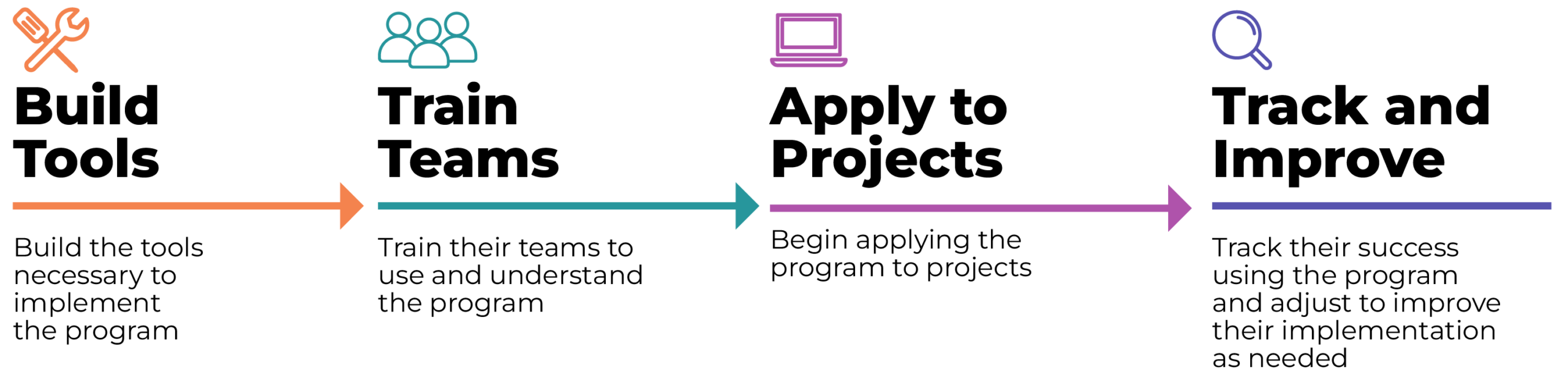
Implementation is planned as a multi-year effort. Initial work focuses on procurement documents and construction specifications, followed by planning and design guidance, training, and other tools needed to support long-term success.
Project teams will document the sustainability features delivered through project development and report results so NMDOT can monitor progress, share lessons learned, and refine the program over time.
Resources
Learn More and Access Program Tools
This webpage is your central location for program materials and additional resources:
Implementation Action Plan Document
About Envision
Envision Framework
NMENV-Lite Checklist
Contact Us
Questions or More Information
For questions about the NMDOT Sustainability Program, Envision, or available resources:
William Hutchinson,
Roadside and Community Design Section Manager
Phone: 505-795-1275
Email: Williams.hutchinson@dot.nm.gov
John Busemeyer,
Landscape and Revegetation Specialist/Environmental Scientist
Phone: 505-490-3985
Email: john.busemeyer@dot.nm.gov
Gerald Lujan,
Sustainability Program Manager
Phone: 505-469-9934
Email: Gerald.Lujan@dot.nm.us